Let me know when that tide's coming in won't you

Let me know when that tide's coming in won't you

Friday, 28 May 2021

Dartford Warbler on the Heath

A long awaited trip to see my parents after seven long months, took me to Norfolk once again. At this time of year the Dartford Warblers are busy nesting. Never the easiest bird to find, as they like to secrete themselves among the gorse and heather. They are a particularly shy bird, unless the male comes out to sing, or they are caught looking for insects and spiders. They do enjoy the sun though, and especially after a cold night. This can bring them higher up the bushes to where you may see them soaking up the warmth.

A lot of waiting is involved when looking for this species. Being able to spot any movement from the corner of your eye is also helpful. I have had many long mornings with nothing to show for my efforts. I have learnt to pick my time of year carefully now, and the reward is great. I would normally have been to look for them a month or so earlier but lockdown rules dictated otherwise, so I was a bit unsure as whether they would be as obliging. A long wait was still involved and the few minutes and seconds I got to see them was well worth it. The difference in time spent waiting and seeing is never fairly distributed, but a fair price to pay for such a fantastic looking bird, and one that we are privileged to have.

The male Dartford Warbler in typical pose.


The slightly duller female soaking up the early morning warmth of the sun.


Friday, 21 May 2021

Flycatchers Are Back!!

I've been fortunate in recent weeks to be able to wait for and then watch the arrival of our Summer Flycatchers. The Pied is always the first to arrive. Not a particularly big bird, it is easy to overlook it as it flashes up to the canopy of the tree. The call is the main give away, if you're lucky to hear it. It's not very loud, or as loud as I'd like it. 

So a small black and white bird in woodland that is difficult to hear. It's always a challenge, but one which I relish each year. It's a great moment when you hear your first, and even better when you catch a glimpse. This is usually followed by very long stints of standing and waiting for it to come closer, or close enough to get some pictures of. These images are the best I could get over numerous visits, and I don't know how many hours. I think they were worth it though.

Male Pied Flycatcher


The wait for arrival into the country is even longer for the Spotted Flycatcher. I don't know if it's because of the extra wait, but this is the one I'm always desperate to set on eyes on. Each year they seem to arrive later and later, but then I check my records and it's exactly the same time as the years before, within just a day or two. For some reason I always look for them a week or two early, in hope more than anticipation. This just means I head home disappointed each time, having not found one 😩.
The build up increases the excitement though, and then you one day there they are. The satisfaction is immense. 
Spotted Flycatcher


Friday, 14 May 2021

Fun on the Water

Red-breasted Mergansers are regularly seen in the lagoon at Cemlyn Bay, but I always seem to struggle to locate them. This is not helped by their liking for diving regularly and staying far away. On this occasion luck was on my side, as I found a pair close to the road side. I managed to pull over and grab the camera from the boot of the car and take a few quick shots before leaving them to it and before I caused a traffic jam.

Female Red-breasted Merganser


The male

A Little Egret was busy in the shallow water.

A bird that is never easy to get close to to take pictures of is the Little Ringed Plover, and it is a bird that I never make any effort to get close to either. It is a Schedule 1 bird which gives it greater protection and should be left to go about it's business as it wishes without interference or harassment from people. I see a few a year locally, and it is always great to watch them. On this occasion though, I was looking through a sight screen when one came and landed just 20 feet away. It didn't know I was there and as it walked around the muddy margins feeding I managed to get some shots of it. A great little bird.


The distinctive yellow eye ring is a key feature to separating it from the larger Ringed Plover, especially at distance.


This is a Ringed Plover seen on the same day, but on a beach. No yellow eye ring, and with orange legs as opposed to the paler pink of the Little Ringed, and orange bill.

Tuesday, 11 May 2021

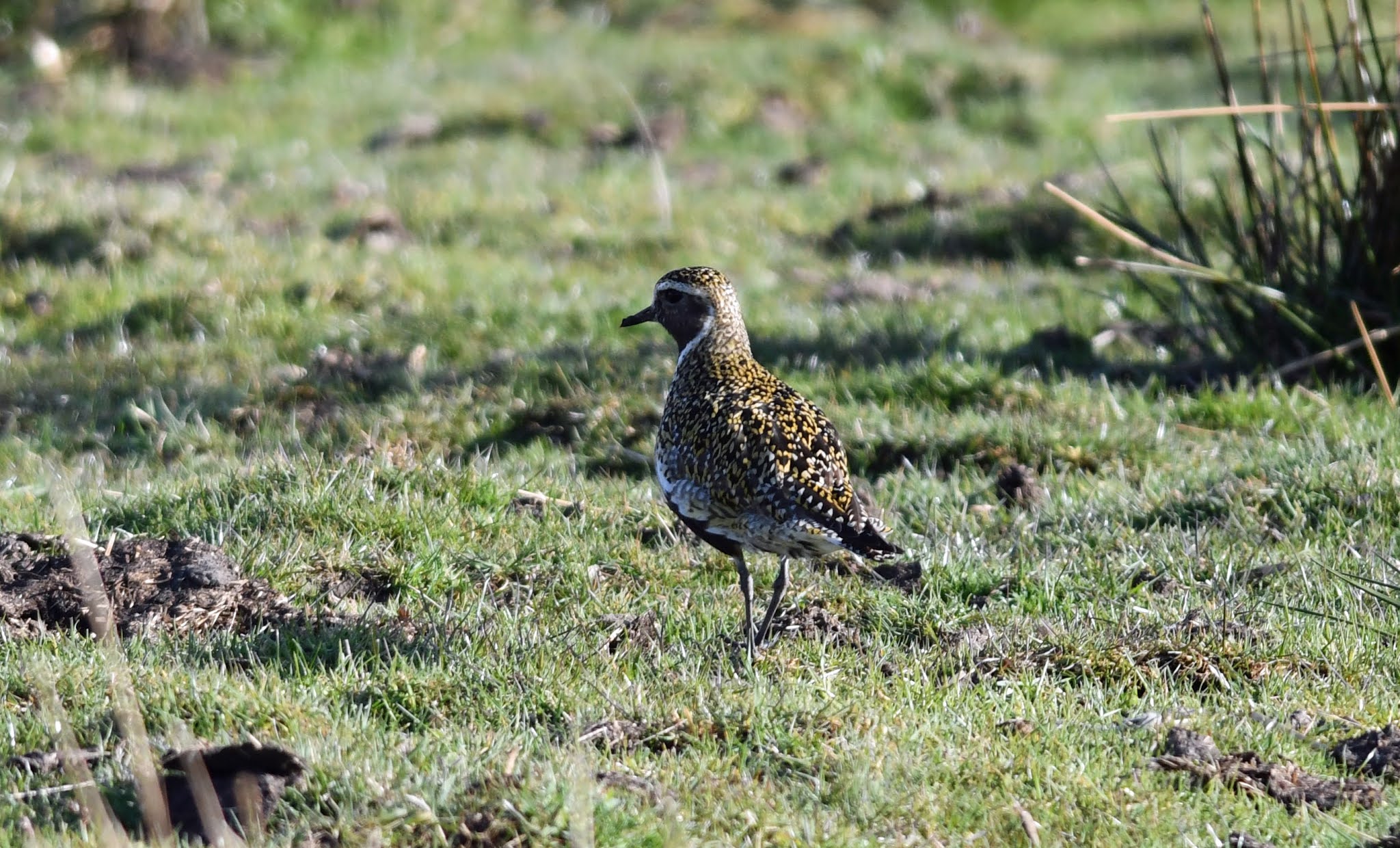
Golden Plover on the moors

Over the past week I've spent a few evenings checking on the local area to see what, if anything, has come in or been moving around. I've managed to locate some pairs of Pied Flycatchers, and Redstarts and even got a nice daytime flypast of a Tawny Owl that I wasn't expecting.

One bird that is not the easiest to see up on the moors is the Golden Plover. I will quite often hear it's haunting calls, but finding them in the scrubby grass, heathers and mosses is a whole different ball game. I happened to pull into a layby where I have seen them in the past. Just a couple of days earlier I had done the same with just one bird seen. On this occasion there were probably about twenty birds, and some quite close by. Again, the careful approach is necessary so as not to spook them. Use of the car, or stone wall is helpful to hide behind. I ended up on tiptoe in the middle of the road and managed not to disturb them. Stunning birds in their summer plumage, and the males looking particularly smart.

A good looking male Golden Plover.


Friday, 7 May 2021

Cemlyn Bay

Last weekend I spent a day in North Wales. It's a trip I really enjoy doing each year. I started out at Cemlyn Bay and was really looking forward to catching up with some waders and Whimbrel in particular. There were lots around the bay, but they are a shy bird that will fly off if they catch sight of you, so caution is always required. Once you have their trust though, you can observe them and watch them go about their business. Slightly smaller than a Curlew, it has a shorter and less curved bill, but a really nice bird that is worth putting extra effort in to see each year.

Whimbrel


The sound that greets you as you arrive at Cemlyn is the unmistakeable sound of the tern colony. Sandwich, Arctic and Common all squawking away. I could watch these all day, and I do regularly in the summer months.
Sandwich Tern with a sand eel.


There was one Mediterranean Gull on the island with the Black-headed Gulls. He seemed like quite a bolshy bird and was aggressively confronting some of the others.

Mediterranean Gull


It was nice to see some of the smaller waders on the shoreline. Some Dunlin here with Ringed Plovers. It reminded me how long it had been since I last watched them. Covid restrictions have kept me away for too long.
Dunlin


Friday, 30 April 2021

Common Redstart - A Real Joy

 One of my favourite Summer migrants is back in the country and I'm so pleased. The Redstart is a bird a long for once we get past the winter months. Countless checks of areas I'm likely to find one start in earnest from the end of March. These are in hope more than belief that one has come across early. Even still, the anticipation on those visits keeps me restless. Is that one? No. Is that one? No. And so the pattern continues, usually until mid April when they do eventually arrive. 

I'm lucky enough to live in an area of the north west where these colourful little birds choose to call home for several months of the year. I've spent some good early mornings with these over recent weeks and they are fascinating to watch, as the males flit between branches and the ground for spiders and insects, and then remember their duty of singing to attract a mate. The song is what gives them away best in wooded areas, because they are not the biggest of birds, and are quite often found up in the canopy of the trees. It's a lovely fluty song. 

Anyway, here is a lovely male Redstart. I hope to see many more in the coming months.


What a beautiful bird, and worth the wait and the many failed attempts to locate one earlier.


Tuesday, 27 April 2021

In Good Company

At this time of year if you venture into the Peak District you are bound to hear the bubbling call of the Curlew. It's a great sound to hear echoing down the valleys, only made better by a fly by.


The Red Grouse are looking in really good condition at the moment. Here is the male with it's striking red eyebrow. This one stayed nicely hunkered down in the heather, but still looked great in the setting sunlight.


This stunning male Stonechat popped up on a post right in front of me as I perched in my car. I was clearly well camouflaged as it stood here for some time surveying the landscape and generally looking very pretty.