Let me know when that tide's coming in won't you

Let me know when that tide's coming in won't you

Saturday, 25 April 2020

Dartford Warbler

This bird I've only seen a handful of times and getting good views is never guaranteed. There are only ways to improve your chances of getting a good view. One of these is visiting at the right time of year and when they are most active. Early Spring is a good time to try and see one of these very secretive Dartford Warblers. This is when they are looking for mates, singing a little more and just a little more showy.
On the whole these diminutive little warblers like to work their way through the gorse and occasionally sit atop.
I was having a very lucky year before the lockdown, but that coincided with me making more effort and trips out to see things so that I could get a list of 200 birds seen in the year. That may not now be possible, but at least I can look back to some very good looking birds already seen and ticked this year.

This female came to see who was walking past.

The male soon showed itself, but only fleetingly. It stayed low on the bush.


Friday, 17 April 2020

Woodlark

Back in March I made a visit to my parents on the North Norfolk coast. At this time of year (and many others if I'm honest) I like to go in search of the Woodlark that I know are often here, but I have yet to successfully find one. Many fruitless trips to their favoured area has always left me disappointed, but I am not one to give up easily.
On this particular occasion I got lucky on two days, with not one but three birds, and at one point all in the air singing. This really was a case of being as cautious as possible. I didn't want to disturb these birds that were obviously setting up territory and pairing up. So I stood very close to a bush and just waited for them to come to me as I melted into the background.
I was rewarded with some very close views, and the real bonus for the first time this year was some very good sunlight.

It was worth the long wait to get some good pictures of these lovely birds.


You can see how I've probably overlooked these birds on many occasions. Once again, nature providing such amazing camouflage. It is there, I promise.


Thursday, 9 April 2020

Summer Visitors during Lockdown

As my camera is currently not aloud out due to the lockdown, I've had to go back to some pictures that I took at a similar time last year. These are of two birds that will almost inevitably serve as a reminder of this terrible COVID-19 lockdown in years to come.

In a year when I was striving so hard to tick off 200 birds, I'd made a fantastic start. Now I'm left wondering if I'll be lucky enough to see our Summer migrants. I understand the importance of the lockdown and I am observing it, it just affects people in different ways.

Anyway, I do enjoy my time outside when I go out and I'm always listening and watching. The sound of the Chiffchaff is a great start to Spring, and I'm hearing more and more of them on my walks.  A great little bird, very similar to the Willow Warbler, which I am hoping that I'll be able to hear or see very soon.

The Chiffchaff


Now, these were a really nice surprise to find last Sunday. Sand Martins!!! I've been waiting for them to arrive, along with the Swallows, and I found 8 of them flying over my local river Bollin where they nest in the river banks. Maybe all is not lost after all. This took my year list to 142.😃


Sunday, 5 April 2020

Black Redstart - Little Orme

One of my intended stop offs on my North Wales trip at the beginning of March was the Little Orme in Llandudno. Black Redstarts are a good possibility here in the winter months in the quarries.

A steep climb had me wishing I had a few less layers on, but that didn't last too long on this cold day.
The tough part of the visit was just about to start though. Spotting a small grey bird amid multi faceted grey rock is not all that easy. The bird does have a nice orange tail, but in shadow it was not that easy to pick up.

Anyway, I did eventually manage to pick up on it's movement and I enjoyed watching it for a good 20 minutes or so, before leaving it to it's own devices, which mainly consisted of flycatching and insect picking.


The view from the top of the Little Orme.

Here is the little bird. So well camouflaged at a distance.


Can you see it? Just slightly left of centre. This was my problem. Without binoculars, I'd say pretty impossible to spot. Perfect habitat.


Saturday, 28 March 2020

Crossbill

A week or so prior to the lockdown I took a drive out to a site I know in Macclesfield Forest, to look for some Crossbills, Siskins and Lesser Redpoll. I'd tried a couple of weeks earlier but with no luck, so was crossing my fingers.
It was classic weather conditions for this area at this time of year. Icy cold, with cloud rolling in like a fog, only to clear just as quickly as it had arrived.
I wandered around the usual areas and had Siskins overhead frequently. Lots of Chaffinch and Goldfinch and then two larger birds appeared and landed high up in one of the conifers. A pair of Crossbill. A female and a very good looking male.

They never really settled and moved off again, but knowing they were around was good. So, I bided my time and employed the age old birdwatchers tool of fieldcraft. Staying in a position so as not to spook the birds and allowing them to go about their business without noticing me. It worked and they came back to a tree not far from me. 😀

Lots of excuses of poor light, fences and branches in the way etc, but it's always such a joy to see these birds whatever the conditions. I could see them very well with my binoculars.
The male in very good condition.


The female, hanging upside down.


Saturday, 21 March 2020

Dippers on the River Goyt

A first visit of the year to the Goyt Valley on the Cheshire Derbyshire border was long awaited. As is my way, I was there early, to hear the chorus of bird song and hopefully catch wildlife in it's pre-human disturbed state.
Thankfully it was dry and bright, which made a change from what has seemed like an eternity of weekends of wet and grey weather. There were lots of birds to listen to. Great Spotted Woodpeckers were pairing up, as were Nuthatch and it seemed like there were hundreds of Coal Tits. Down on the river Goyt, the water level was well up but I managed to find a Dipper up stream.
I've not cropped or zoomed in on any of these pictures, just to give a sense of how I saw it. Binoculars are always around my neck, but this was easy to pick out on the rocks.


Friday, 13 March 2020

Cemlyn Bay - Anglesey

I spent a full day in North Wales last weekend, stopping at sites from Llanddulas all the way out to Holyhead and South Stack. I did a bit of sea watching first from the shoreline of Llanddulas, where I quickly picked out a pair of Red-breasted Merganser followed by hundreds of Common Scoter. A Great Northern Diver went by too before I moved on.
I headed to Cemlyn Bay where I had been once before and was impressed by the birds on show. This time was no different, with lots seen that I wasn't really expecting.

A Whimbrel was the first bird I stumbled across. I'd been tipped off that there was one over wintering here, but wasn't really expecting to find it. Thankfully I did, although it didn't hang around long before moving off.


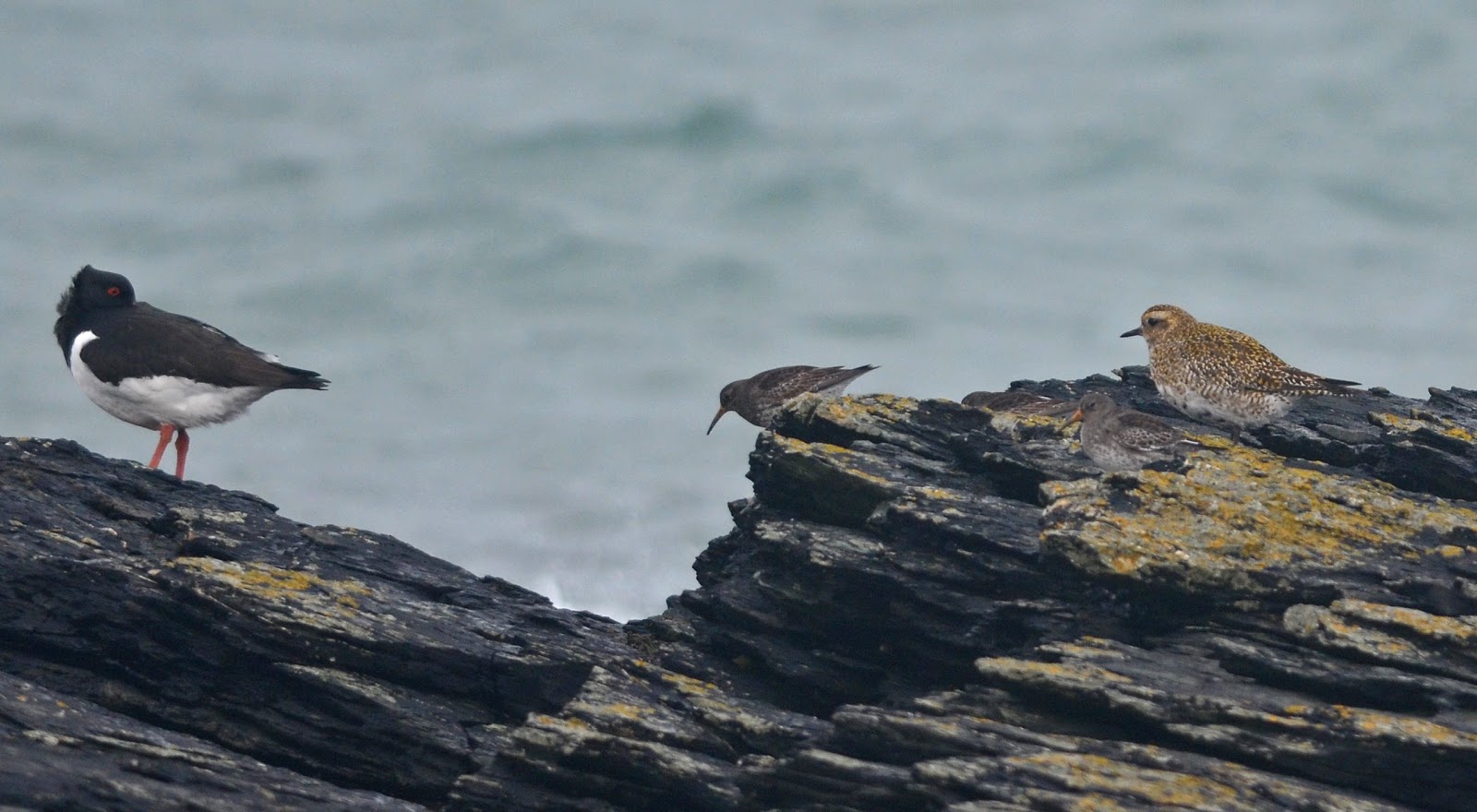
Golden Plovers were also a nice surprise. Always a very obliging bird but usually at some distance. I kept mine from this one out on the rocks.

It was soon joined by other waders, like this Oystercatcher.


A flock of 10 Purple Sandpipers were a real bonus.


Here's 7 of them together.

It took me a few glances through the binoculars at these, as I initially passed them off as Golden Plover, but they were just too pale. These are in fact Grey Plover, with one showing off the nice black underwing to confirm my doubting mind.


A pair of Dunlin at bottom left an Oystercatcher on the right of picture.


A very nice looking Ringed Plover was one of a few around.


Friday, 28 February 2020

Etherow Park Marsh Tit

I popped along to Etherow Park in Marple at the weekend, and I was on the look out for a Marsh Tit. A very unusual bird for Stockport and the Manchester area in general. I had seen one the previous week in Norfolk, but quite fancied ticking this closer to home, and it was handily spending a lot of its time around a feeding station and hide. This meant that I could sit for a couple of hours and just enjoy what nature brought to me.
It seemed that it was bringing every other Tit species apart from the Marsh variety. It was cold with the odd downpour thrown in, but it meant the birds were quite active and gave me plenty of opportunity to photograph them at relatively close quarters. All of them had wonderful plumage and they looked in good shape and set for Spring.

The Marsh Tit don't show while I was there, but here is the bird I photographed last week at Sculthorpe Moor.

One of the many Blue Tits that was busy at the feeding station.


The Coal Tit. I was very grateful of the hide to be able to photograph this bird. They're so fast, but this guy was very comfortable, and I was even able to photograph it eating. A first for me, as they normally bolt off to the safety of a tree to eat.


Eating a sunflower heart from between it's tiny feet.

A very handsome and shiny looking Great Tit.


Friday, 21 February 2020

Sheringham Beach - Purple Sandpiper & Caspian Gull

I spent a good long weekend down at my parents in Norfolk, and that always means plenty of opportunity to add some year ticks. A bird that is a regular during the winter months is the Purple Sandpiper that can be found on the large granite rocks on the Sheringham coast. There were a pair around, and I was able to see at least one on most days. One of my favourite wading birds, I look forward to seeing these well camouflaged creatures.


Typically in amongst the crashing waves at high tide.


A bird that has also been on the beach recently is this juvenile Caspian Gull. A 1st winter individual, this was only the second time that I've seen one, so it was good to be able to stand and study it for a while as it mingled with some juvenile Herring Gulls.


The Caspian Gull can be seen here in the centre, and is noticably lighter in colour to the Herring Gulls either side of it.